

The Inspector General Forgot How to Investigate Fraud
Document ID: OSIG-DPOR-031825
Document Type: Regulatory Complaint Rejection & Statutory Cross-Reference
Date of Action: March 18, 2025
Complainant: Virginia Consumer Inc.
Target Agency: Department of Professional and Occupational Regulation (DPOR)
Reviewing Body: Office of the State Inspector General (OSIG)
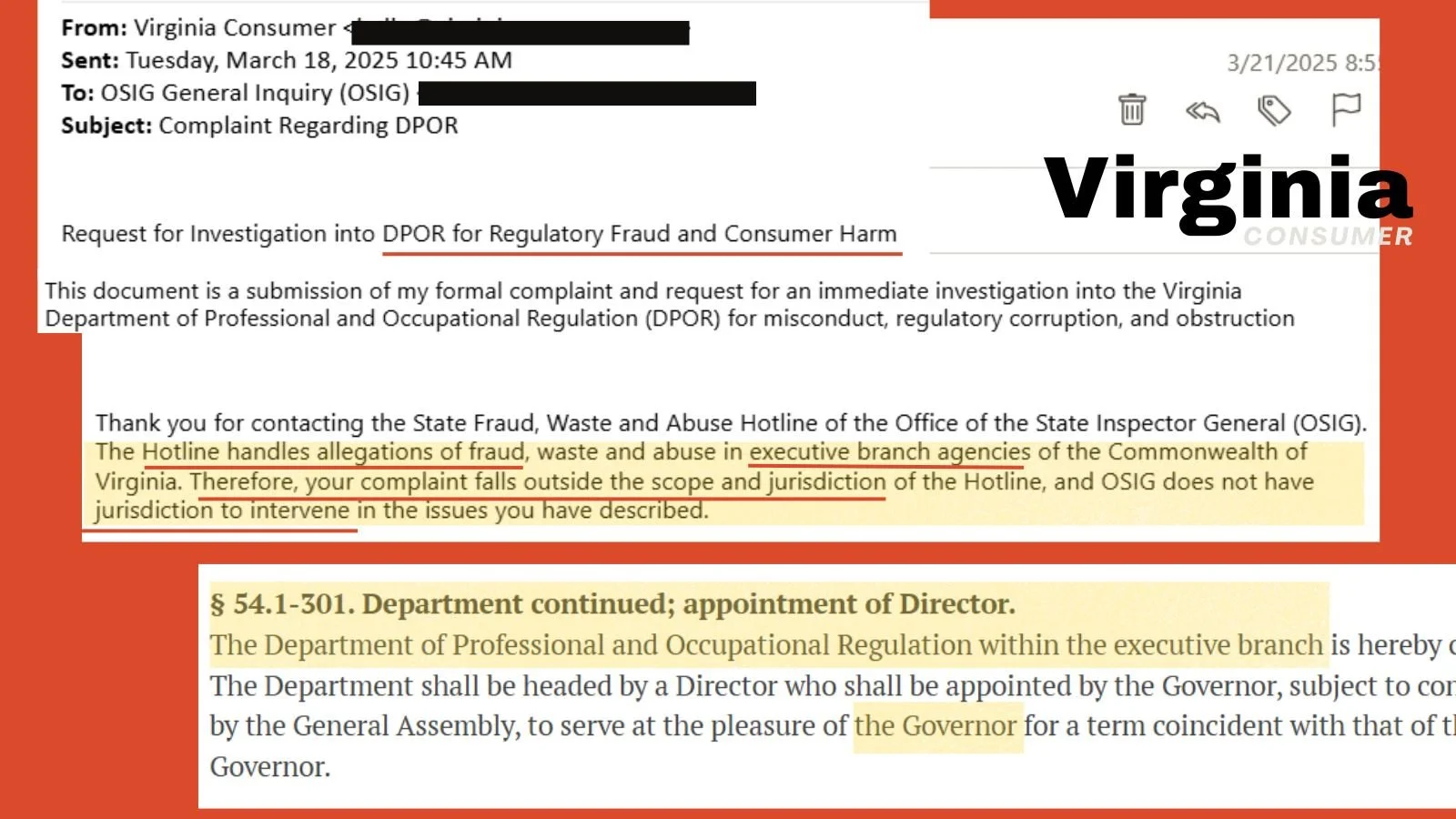
The exchange between the Virginia Consumer and the Office of the Inspector General of Virginia
Executive Summary
This record documents an administrative jurisdictional denial by the Office of the State Inspector General (OSIG) regarding a formal request for investigation into the Department of Professional and Occupational Regulation (DPOR) for alleged regulatory fraud, misconduct, and consumer harm. It highlights a critical contradiction between OSIG’s stated grounds for dismissal and explicit Virginia statutory law.
Key Evidence & Findings
The Complaint (Top): On March 18, 2025, Virginia Consumer Inc. submitted a formal request to the State Fraud, Waste, and Abuse Hotline seeking an investigation into DPOR's failure to protect consumers from predatory construction practices.
The OSIG Denial (Middle): OSIG summarily closed the inquiry, stating that the Hotline's jurisdiction is strictly limited to "executive branch agencies of the Commonwealth of Virginia." OSIG explicitly asserted that the DPOR complaint fell "outside the scope of the Hotline" and that they lacked authority to intervene.
The Statutory Fact-Check (Bottom):Virginia Code § 54.1-301 explicitly refutes OSIG's jurisdictional claim, stating verbatim:
"The Department of Professional and Occupational Regulation within the executive branch is hereby continued." Regulatory Implications This document serves as evidence of structural stonewalling and systemic failure within Virginia's administrative oversight mechanisms. By mischaracterizing a cabinet-level executive agency's status to evade a investigative hotline report, the State Inspector General's office effectively insulated DPOR from accountability, leaving injured Virginia consumers with no administrative recourse.
